
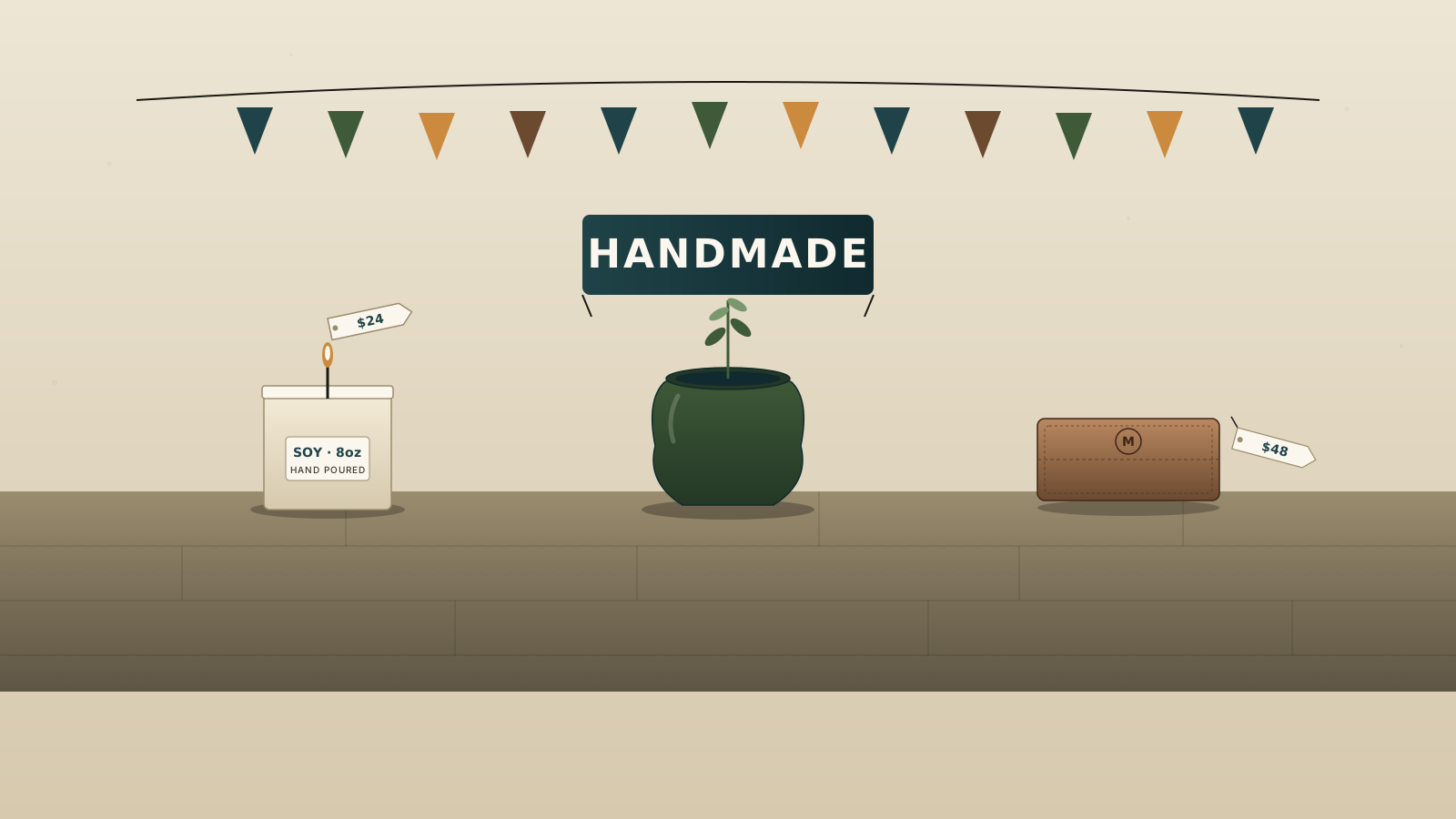
Most makers leave 20-40% on the table at every show. Not because they're bad at math, because the pricing conversation is genuinely hard, and most pricing advice on the internet is either copy-pasted from etsy listicles or written by people who've never actually run a booth.
Here's the framework that's worked across 47 shows for one veteran vendor, and the actual math that goes with it.
Step 1: Cost-of-goods times four (the floor, not the price)
Take everything that goes into the piece:
- Raw materials. Wax, wick, jar, label. Wire, beads, clasp, packaging. Round up. You'll forget the shipping tape and the gas to the supply store.
- Time. What's an hour of your work worth? Don't say $10. The federal minimum wage is a regulatory floor, not a craft-business price. Pick something you'd be proud to defend out loud. $20-$30 is normal for skilled handwork.
- Booth-fee amortization. A $40 booth selling ~200 units is $0.20/unit. A $400 invite-only show selling ~50 high-margin pieces is $8/unit. Always do this math; promoters don't.
Add them up. Multiply by four. That's your floor, not your price. Most makers stop at 2× and wonder why they're tired and broke.
"I doubled my prices six months in. Sold the same volume. My partner stopped asking when I was going to get a real job." Riley H., chandler, Tulsa OK
Worked example: an 8oz soy candle
| Line | Cost |
|---|---|
| Wax (8oz) | $0.85 |
| Wick + tab | $0.08 |
| Jar (clear glass) | $0.85 |
| Custom label + tape | $0.32 |
| Time (10 min at $20/hr) | $3.33 |
| Booth-fee amortization (avg $40 booth, ~200 sold) | $0.20 |
| Total cost | $5.63 |
| × 4 floor | $22.52 |
Round up to $24. If someone says "wow, that's pricey for a candle." That customer wasn't yours anyway.
Step 2: Three tiers, every booth
Don't bring fifteen $24 candles and a sad sign. Bring three tiers:
- Impulse ($5-$8). Wax melts. Stickers. Lip balm. Earring pairs. These are conversation starters. They drive email signups. They're not where the money is.
- Mid ($20-$30). Your hero product. The 8oz candle. The pendant. The handbound notebook. This is where most of your margin lives.
- Flagship ($60+). One or two showpieces. The poured-and-carved sculptural candle. The full set of six. These rarely sell, but they make the $24 candle look like a steal by comparison, and they're the photo customers take home in their head.
Three tiers also lets you say yes to the customer who asks "is there anything under $10?" without slashing the price of your hero work.
Step 3: Round to read-aloud numbers
$22.52 is the math. The price tag should say $24 or $25. Maybe $23, never $22.99. The reason isn't psychology: it's that customers at a craft fair are doing math in their heads, in line, often with sticky kid hands.
- Read-aloud test. "It's twenty-four dollars." Sounds confident. "It's twenty-two ninety-nine." Sounds like a gas station receipt.
- Cash-friendly. Pricing in $5 increments means you make change with $5s and $20s, never $1s. Saves time per transaction, which compounds over a busy market.
A few common objections
"My competitor sells the same thing for $14."
Two responses. One: your competitor is leaving money on the table. That's their problem, not your strategy. Two: you're not selling the same thing. They sell a candle. You sell your work, with your story, in a jar you picked, at a booth you set up at 6am. Don't compete on price with someone who's underpricing themselves.
"I tried higher prices and sold less."
Possibly. More likely: you raised prices without raising presentation. Higher prices need better signal, a real tablecloth, a price card customers can read from six feet away, eye contact with the people browsing. The price is part of the costume; if the costume doesn't match, the customer feels it.
"I'm selling to friends and family at shows."
That's nice. They'd also be happy to pay the real price and brag about you. Charge it. Give the people you love your time, not a discount.
What to track
Three numbers, per show:
- Gross sales, already in your own sales log.
- Number of units sold, quick mental math from gross ÷ avg price.
- The piece you wish you'd brought more of. Write it on the back of the booth-fee receipt. Read it before the next show.
Most pricing improvements come from the third number, not the first two.
A simple way to track it
The fastest way to know whether your new pricing is working is to log each show right after you tear down, while it's still fresh. Write down gross sales, booth fee, cost of goods, and your mileage, then do the simple subtraction for net per show. A notes app or a cheap spreadsheet is plenty.
After three or four shows, sort them best-net first. That ranking tells you which shows to repeat next season and which ones to skip, and it's worth more than any single sale. Keep the mileage and booth fees broken out as you go, and tax season stops being a shoebox of receipts.
It's the difference between thinking your prices are working and knowing they are.
Want help with the math for your specific work? Drop a comment with your category (leather, ceramics, baked goods, whatever) and I'll write a follow-up worked example.